
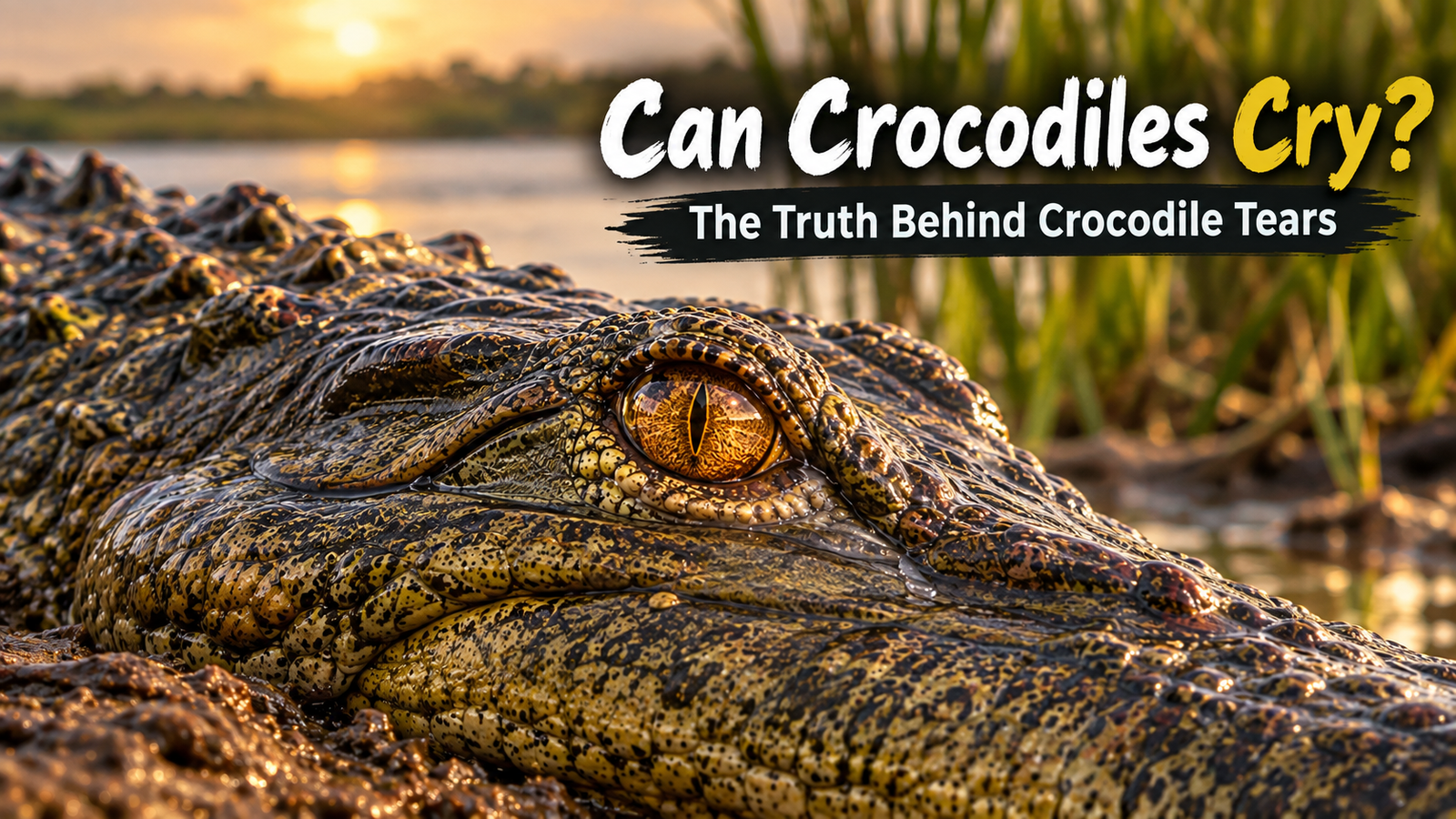
Can crocodiles really cry? Discover the science behind crocodile tears, why they may appear while feeding, and whether crocodiles actually feel sadness.
Have you ever heard someone say they are shedding “crocodile tears”?
The expression usually means someone is pretending to be sad or showing fake sympathy.
But here’s the surprising part:
Crocodilians really can produce tears.
Scientists have observed tearing in crocodilian relatives such as alligators and caimans while they were feeding. However, that doesn’t mean these animals are crying because they feel sad, guilty, or sorry for their prey.
So, can crocodiles cry?
The real answer is much more fascinating.
What Are “Crocodile Tears”?
“Crocodile tears” is a phrase used to describe insincere or fake sadness.
The expression comes from the old belief that crocodiles shed tears while eating their prey.
For centuries, this idea was treated almost like a legend. But scientists eventually investigated whether crocodilians actually produce tears during feeding.
And the evidence showed something surprising.
They can.
Table of Contents
Scientists Observed Real Tears
In a study published in BioScience, researchers observed American alligators and caimans while they were eating.
The researchers examined seven crocodilians and observed visible moisture or tearing in five of the seven animals during feeding. Some animals even developed bubbles around their eyes.
This provided scientific evidence that the famous phenomenon behind “crocodile tears” is not completely fictional.
But there’s an important distinction:
Real tears do not automatically mean real sadness.
Why Do Crocodilians Produce Tears While Eating?
Scientists have proposed several possible physiological explanations.
One possibility involves the physical mechanics of feeding.
During an intense feeding response, crocodilians make powerful jaw movements and may force air through their sinus passages. Researchers suggested that these physical effects could contribute to fluid being pushed toward or released around the eyes.
The muscles and structures around the eyes may also be affected by powerful jaw movements.
However, scientists have not established one universal mechanism that explains every instance of tearing in every crocodilian species.
So it’s more accurate to say that feeding can be associated with tearing, rather than claiming that crocodiles deliberately cry while eating.
Are Crocodile Tears Emotional?
This is where the myth gets interesting.
There is no good evidence that the tears observed during feeding represent human-like emotional sadness.
In fact, tears serve important biological functions across many animals.
They help keep the eye surface moist, protect the eye, and maintain healthy vision.
Research on reptile tears has shown that crocodilian relatives have complex tear systems with chemical characteristics important for maintaining the eye.
So when you see moisture around a crocodilian’s eyes, it doesn’t necessarily mean the animal is emotionally upset.
A tear is not automatically an emotion.
Why Don't We Usually Notice Crocodile Tears?
There’s another fascinating detail.
Crocodilians spend a great deal of time in or around water.
That makes small amounts of eye moisture difficult to see.
Researchers and crocodile experts have noted that tears can be much easier to observe when the animal’s head is relatively dry, particularly when feeding on land.
In water, the moisture around the eye can simply blend into the surrounding environment.
That’s one reason the phenomenon may seem mysterious.
Do All Crocodiles Cry?
Not necessarily in the way the popular phrase suggests.
The strongest experimental evidence for feeding-associated tearing comes from studies involving several crocodilian species, particularly alligators and caimans.
Crocodilians include crocodiles, alligators, caimans and gharials.
Their eye anatomy and tear-producing structures are complex, and researchers continue to study how these systems work.
So it’s better to avoid saying:
“Every crocodile cries when it eats.”
A more scientifically accurate statement is:
Some crocodilians have been observed producing tears or eye moisture during feeding.
Crocodile Tears: Myth vs. Fact
Popular Belief | Scientific Reality |
|---|---|
| Crocodiles cry because they feel guilty | No evidence supports this |
| Crocodile tears are completely fake | The tears themselves can be real |
| Tears only happen because crocodiles are sad | Tears have important physiological functions |
| Crocodilians can produce eye moisture while eating | Yes, this has been observed |
| Every crocodile must visibly tear while feeding | Not established |
| “Crocodile tears” means fake sadness | Yes, in everyday language |
🧠 The Bigger Lesson
The story of crocodile tears is a perfect example of how a fascinating animal behavior can become a human myth.
People saw moisture around a crocodilian’s eyes and interpreted it through a human emotional lens.
Science tells us something different.
The tears can be real.
But the sadness is the part we cannot assume.
That distinction is important whenever we study animal behavior.
Animals can have complex physiological responses without those responses having the same emotional meaning they have in humans.
🐊 Final Answer: Can Crocodiles Cry?
Yes, crocodilians can produce tears.
Scientists have documented tearing and eye moisture associated with feeding in several crocodilian species.
But there is no evidence that these tears mean the animal is feeling sad, guilty, or sorry for its prey.
So the next time someone says they’re crying “crocodile tears,” remember:
The tears may be real—but the sadness is the myth.
Nature is often stranger than the stories we tell about it.
❓ Frequently Asked Questions
Crocodilians can produce tears and eye moisture. Studies have documented tearing associated with feeding in several crocodilian relatives, including alligators and caimans.
Tears help maintain and protect the eye. Feeding-associated tearing may also result from physiological effects connected with feeding, although the exact mechanism is not completely established for every species.
There is no evidence that feeding-associated crocodilian tears represent human-like emotional sadness.
The phrase comes from the long-standing belief that crocodiles shed tears while consuming prey. The expression eventually became a metaphor for fake or insincere sadness.
That claim would be too broad. Scientific observations have documented feeding-associated tearing in several crocodilian species, but it should not be assumed that every crocodile visibly tears during every meal.
Crocodilian tears serve biological functions such as maintaining the eye. Research has found interesting similarities in the chemical composition of tears across reptiles, birds and mammals, although there are also differences between species.
🔬 Scientific Sources
- Shaner, D. M., & Vliet, K. A. “Crocodile Tears: And thei eten hem wepynge.” BioScience, 2007. Oxford Academic
- Rehorek et al. “Alligator tears: A reevaluation of the lacrimal apparatus of the crocodilians.” Journal of Morphology, 2005. PubMed
- University of Florida — Crocodile Tears, reporting on Kent Vliet’s research. UF News Archive
- National Geographic — research on reptilian tears and crocodilian eye physiology. National Geographic