
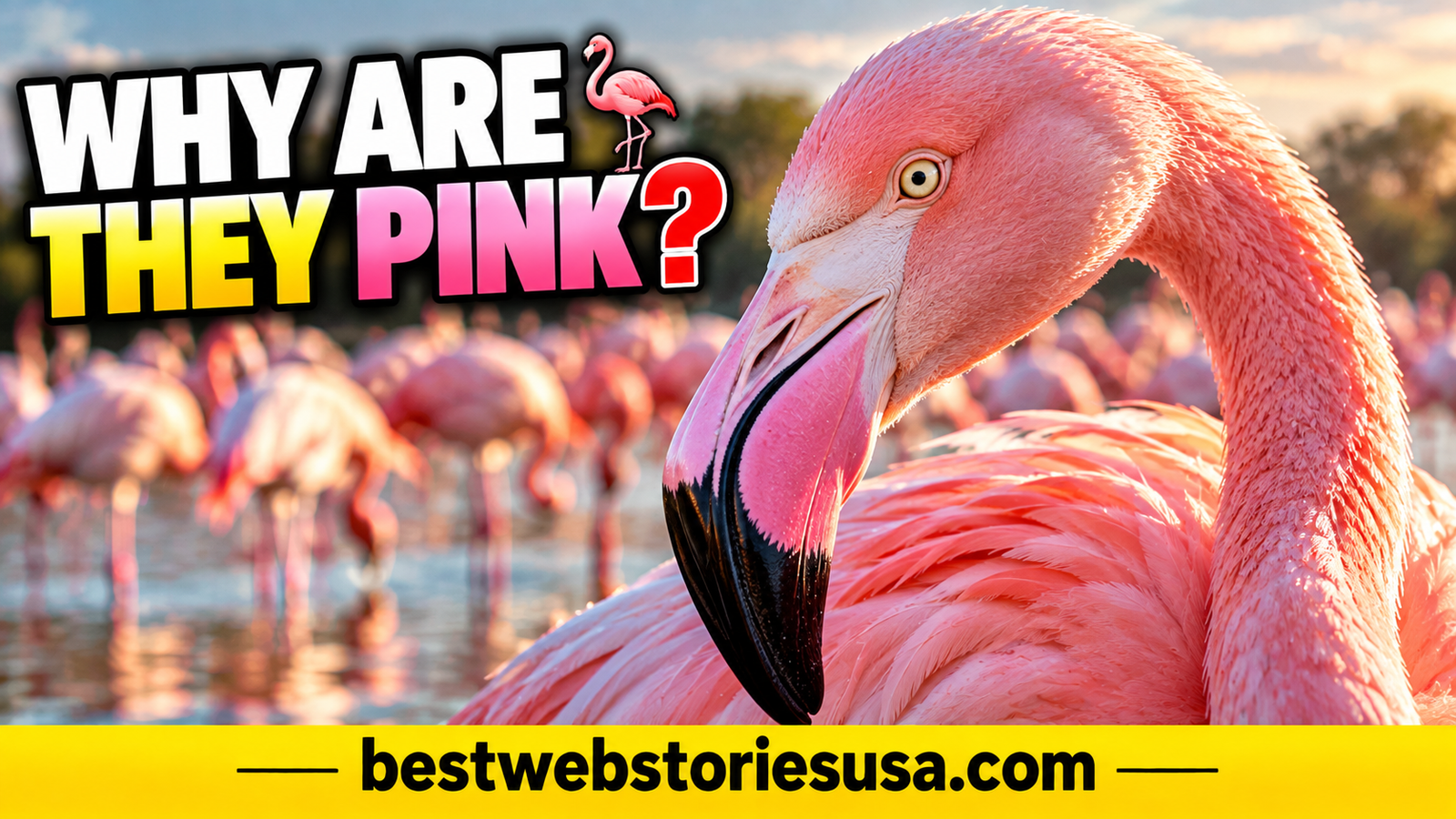
Why are flamingos pink? Discover how carotenoid-rich foods, digestion and biology give flamingos their famous pink and reddish feathers.
🦩 Why Are Flamingos Pink? The Science Behind Their Famous Color
Few birds are as instantly recognizable as the flamingo.
With their long legs, curved bills and striking pink feathers, flamingos seem almost too colorful to be real.
But here’s something surprising:
Flamingos aren’t born pink.
Their famous coloration develops largely because of what they eat.
The secret involves a group of natural pigments called carotenoids.
So how does a bird’s diet turn its feathers pink?
Table of Contents
🌿 It Starts With What Flamingos Eat
Flamingos feed in shallow wetlands, lagoons and other aquatic environments.
Their diets can include algae and small aquatic organisms, depending on the species and habitat. Some of these foods contain carotenoid pigments.
Carotenoids are naturally occurring pigments found throughout the food web.
They’re responsible for many of the yellow, orange and red colors seen in plants and animals.
And in flamingos, they help create the bird’s characteristic pink-to-red appearance.
🧬 What Are Carotenoids?
Carotenoids are a large family of natural pigments.
You encounter them in many familiar foods.
Carrots contain carotenoid pigments.
So do some algae and other plants.
In birds, carotenoids can contribute to colorful feathers and skin.
When flamingos consume carotenoid-rich food, their bodies process and distribute these pigments. Some are deposited in tissues including feathers and skin, contributing to the bird’s characteristic coloration.
That’s why the flamingo’s color is ultimately connected to its diet.
🐣 Baby Flamingos Aren't Bright Pink
This may be the easiest way to understand the process.
A newly hatched flamingo does not look like the bright-pink adult standing beside it.
Flamingo chicks are generally covered in soft greyish or white down.
As they grow and consume their specialized diet, their coloration gradually develops.
The transformation isn’t an overnight change.
It’s a gradual biological process.
Greyish chick → dietary pigments → developing coloration → adult pink.
🦩 Why Are Some Flamingos Pinker Than Others?
Not every flamingo has exactly the same shade.
Some birds can appear pale pink.
Others have deeper pink, coral or reddish tones.
Color can vary with species, diet and individual biological differences.
This means the flamingo’s appearance can tell us something about its biology—but we shouldn’t assume that a darker bird is automatically healthier or a better mate.
Animal coloration is often more complicated than a simple “brighter is better” rule.
🍤 Do Flamingos Get Their Pink Color From Shrimp?
You’ve probably heard the claim that flamingos are pink because they eat shrimp.
There’s some truth behind the popular explanation—but it’s incomplete.
Small aquatic organisms such as brine shrimp can be sources of carotenoids, but flamingos also consume algae and other food depending on species and habitat.
So saying:
“Flamingos are pink because they eat shrimp.”
is an oversimplification.
A better explanation is:
Flamingos consume carotenoid-containing foods, and those pigments contribute to their coloration.
🌊 Why Do Flamingos Feed in Shallow Water?
Their unusual bills are perfectly suited to their feeding lifestyle.
Flamingos can use their bills to filter food from water and mud.
Different flamingo species have different feeding strategies, but many are adapted to feeding in shallow aquatic environments.
Their specialized feeding behavior allows them to exploit food resources that many other birds cannot use as effectively.
And that food provides the pigments that eventually contribute to their famous appearance.
How Do Carotenoids Reach Their Feathers?
After a flamingo consumes carotenoid-containing food, the pigments are absorbed and transported through the body.
Some become incorporated into growing feathers and other tissues.
As feathers develop, carotenoids contribute to their pink, orange and reddish coloration.
This means the color isn’t simply painted onto the outside of the feather.
It’s connected to the bird’s internal processing of dietary pigments.
That’s why a flamingo’s diet can have such a visible effect on its appearance.
🧪 Is Pink Coloration Only About Appearance?
Not necessarily.
Carotenoids can have biological functions beyond simply producing color.
They are involved in antioxidant processes and other physiological functions in animals.
However, we should be careful about assuming that every visible shade of pink directly reflects an individual’s health or nutritional condition.
The relationship between coloration, diet, physiology and reproduction can be complex.
🧠 Myth vs. Fact
| Popular Myth | Scientific Reality |
|---|---|
| Flamingos are born pink | Young flamingos are generally greyish or white |
| Flamingos are pink because they eat only shrimp | Their diet includes carotenoid-containing algae and aquatic organisms |
| Their feathers are naturally neon pink | Natural coloration ranges from pale pink to deeper reddish shades |
| Sunlight makes flamingos pink | Dietary carotenoids are the key source of pigmentation |
| Flamingos deliberately dye their feathers | The color develops through normal biological processing |
| Every flamingo is the same shade | Color varies among individuals and species |
🌍 Why Is This Adaptation So Fascinating?
The flamingo is a beautiful example of how an animal’s appearance can be connected directly to its environment.
Its food provides pigments.
Its body processes those pigments.
Its feathers display the result.
In other words:
The wetland ecosystem becomes part of the flamingo’s color.
The algae and tiny organisms living in the water ultimately help create one of the most recognizable colors in the animal kingdom.
🦩 Final Answer: Why Are Flamingos Pink?
Flamingos are pink primarily because their diet contains carotenoid pigments.
These pigments come from foods such as algae and small aquatic organisms. After the flamingo processes them, carotenoids contribute to pigmentation in its feathers, skin and other tissues.
Young flamingos start out greyish or white, and their adult coloration develops gradually as they grow and feed.
So the next time you see a bright-pink flamingo, remember:
Its color isn’t just beautiful.
It’s a biological story written by its diet. 🦩🌿
❓ FREQUENTLY ASKED QUESTIONS
Flamingos get much of their characteristic pink and reddish coloration from carotenoid pigments in their diet.
No. Flamingo chicks are generally greyish or white and develop their adult coloration gradually.
Their diet can include carotenoid-rich algae and aquatic organisms such as brine shrimp. The exact diet varies among species and habitats.
No. Their coloration can vary from pale pink to deeper pink or reddish shades depending on species, diet and individual biology.
Their coloration can change with diet and feather replacement. Because carotenoids are continually involved in pigmentation, food availability can influence how intense their color appears.
Shrimp can contribute carotenoids, but they are not the only source. Flamingos can obtain these pigments from algae and other aquatic food sources.
Yes. Carotenoids have biological roles beyond coloration, including antioxidant-related functions.
Young flamingos have not yet developed the adult feather coloration associated with dietary carotenoid accumulation, so they appear greyish or white.
📚 RESEARCH SOURCES -
- San Diego Zoo Wildlife Alliance — Flamingo biology and coloration.
- Smithsonian’s National Zoo — Flamingo diet and biology.
- San Diego Zoo Wildlife Explorers — Flamingo chick development.
- Encyclopaedia Britannica — Flamingo biology and coloration.
- Scientific literature on carotenoid pigmentation and physiological function.